
Table of Contents
Introduction
If you're new to SEO, you've probably heard that backlinks are one of the most important ranking factors for search engines. A backlink is simply a link from one website pointing to another. When another site links to your page, search engines treat it as a small vote of confidence — a sign that your content might be useful, trustworthy, or worth citing.
Backlinks matter because they influence your website authority, help search engines discover new pages faster, and contribute to your overall off-page SEO. Websites with a healthy backlink profile — meaning a mix of relevant, natural, and diverse referring domains — tend to have an easier time competing in search results.
Here's the good news: you don't need a big budget to start building backlinks. Many beginners assume link building requires expensive tools, paid placements, or agency help. In reality, learning how to get backlinks without spending money is entirely possible if you're willing to put in consistent effort.
This guide focuses on free backlink strategies that are sustainable and won't put your site at risk. It's also worth remembering early on: quality and relevance matter far more than quantity. Ten relevant, editorially earned links from real websites in your niche will do more for your SEO than a hundred spammy, irrelevant ones. Search engines are increasingly good at spotting the difference, so this article will show you how to focus your energy where it actually counts.
What Are Backlinks and Why Do They Matter?
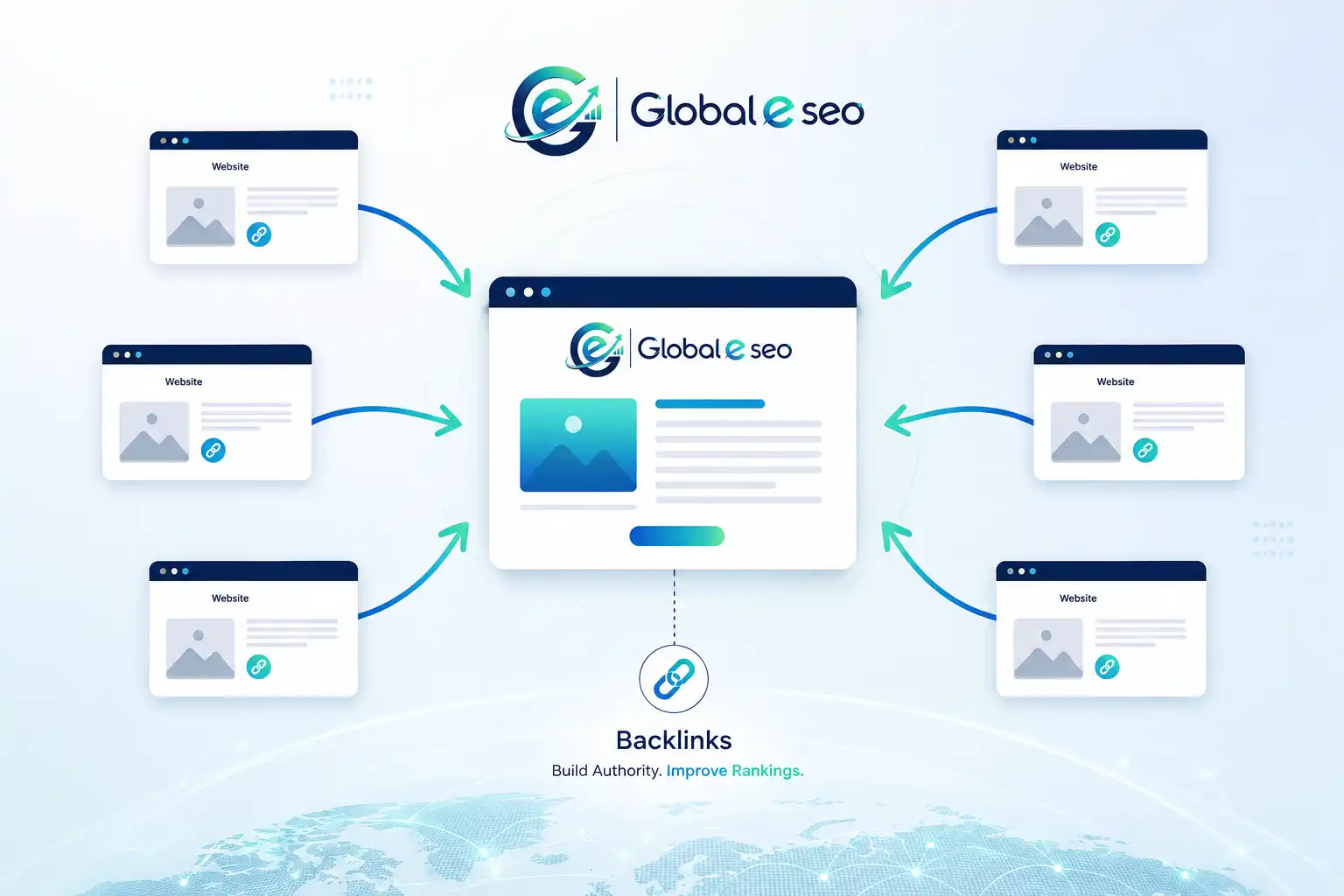
In simple terms, a backlink is a hyperlink on another website that leads back to yours. If a blogger writes an article and links to your site as a source, that's a backlink. If a business directory lists your website, that's also a backlink.
Search engines use backlinks as one of many signals to understand how trustworthy and relevant a website is. Generally speaking, when a page earns links from a range of relevant, credible referring domains, it signals to search engines that the content is worth surfacing in results.
But not all backlinks are equal. It helps to understand the difference:
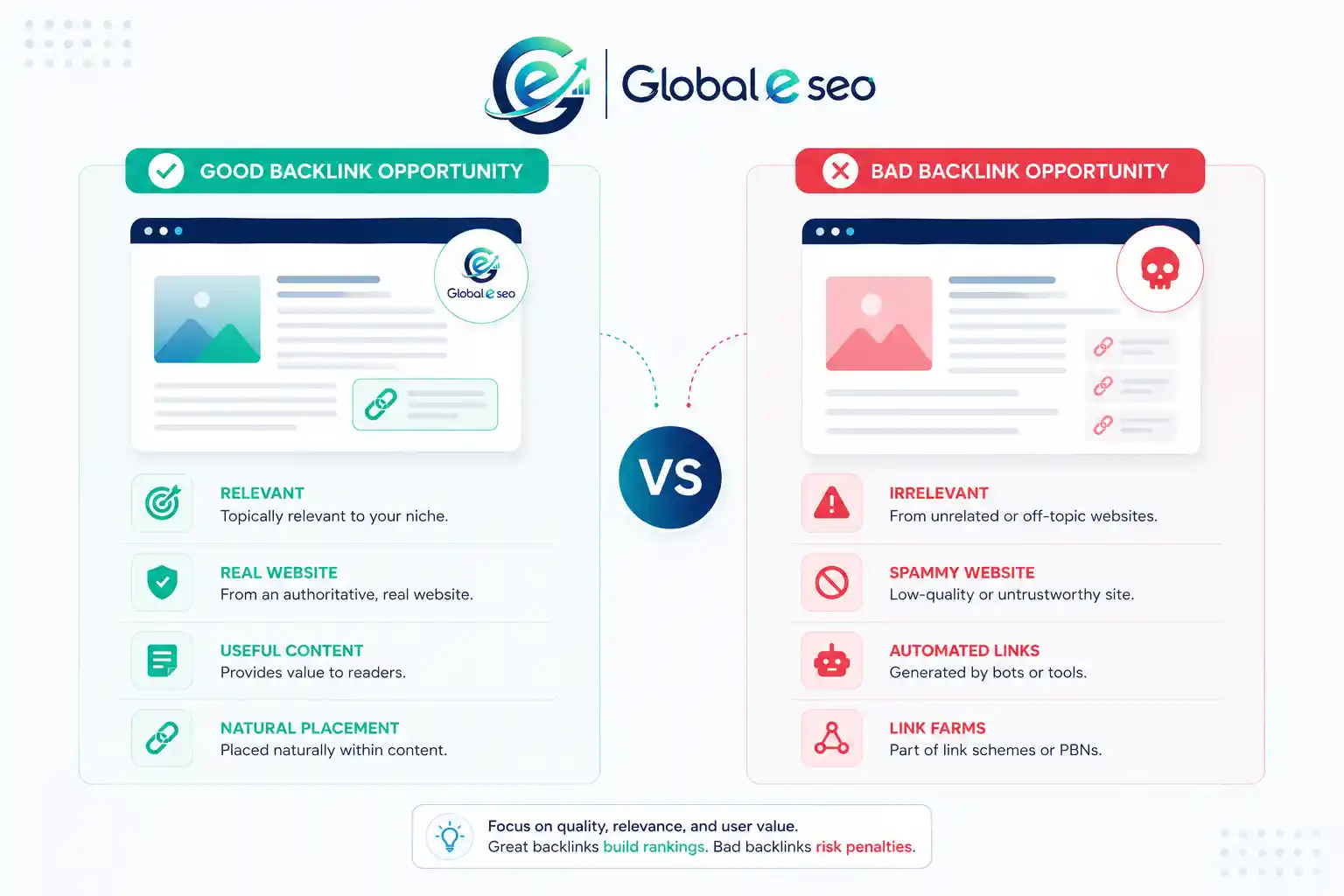
A relevant, quality backlink typically:
- Comes from a website in your niche or a related industry
- Is placed naturally within useful content
- Sends real visitors, not just "SEO value"
- Comes from a site with genuine editorial standards
A low-quality or spammy backlink typically:
- Comes from an unrelated or low-effort website
- Is part of a link farm or automated network
- Uses unnatural or repetitive exact-match anchor text
- Was created purely to manipulate rankings, not to help readers
This distinction matters because a backlink profile full of manipulative links can actually hurt you, while a smaller number of relevant, organic backlinks can meaningfully support your rankings over time.
How to Get Free Backlinks
There are several legitimate ways to build backlinks without paying for placements. Learning how to get free backlinks starts with understanding that most valuable links are earned, not bought. Here are the core approaches beginners can use:
- Create content that naturally attracts links — guides, tutorials, and original data that other sites want to cite.
- Reach out directly to website owners, bloggers, and journalists who cover related topics.
- List your website on relevant, legitimate directories and site lists.
- Repair broken links on other websites by suggesting your content as a replacement.
- Build genuine relationships with people in your industry so links happen naturally over time.
None of these require a budget — they require time, patience, and a willingness to provide real value to other website owners and their audiences.
Free Backlink Sites: What Should You Look For?
Not every site that offers a "free backlink" is worth your time. Before submitting your website anywhere, evaluate the opportunity using these criteria:
- Relevance — Does the site relate to your niche or industry in some way?
- Website quality — Is the site well-maintained, indexed by Google, and free of obvious spam?
- Real audience — Does the site appear to have actual visitors, or does it exist purely to host outbound links?
- Editorial value — Is your listing or link placed in a way that adds value to a reader, rather than being stuffed in a link list with no context?
- Natural placement — Does the link fit naturally within the page, rather than looking forced or manipulative?
- Spam signals — Watch for sites with excessive ads, broken navigation, no contact information, or a pattern of linking to unrelated, low-quality websites.
Not every free backlink site is worth using. Some directories exist purely as link farms with little real value, and submitting to low-quality directories in bulk can do more harm than good. Be selective, and treat every submission as something that should genuinely help a visitor, not just your backlink count.
If you'd rather skip the manual outreach and let a team manage the process for you, our off-page SEO and link building service handles vetting, outreach, and reporting on your behalf.
A helpful example of a legitimate free listing opportunity is GlobalESEO.com. GlobalESEO.com allows website owners to add their website to its site list and provides a free backlink opportunity through that listing. When using a platform like this, it's a good idea to:
- Add accurate and complete website information
- Follow the platform's submission guidelines carefully
- Use a relevant, honest website description
- Avoid submitting spam, duplicate, or unrelated websites
It's worth being clear-eyed about what a listing like this can and can't do. A backlink from GlobalESEO.com, or any similar site list, does not guarantee higher Google rankings, and it won't automatically increase your Domain Authority or Domain Rating. The actual SEO value of any backlink — including this one — depends on factors like relevance, the quality of the linking page, the surrounding context, and whether search engines consider the link genuinely valuable. Think of it as one small, legitimate piece of a much larger link building effort, not a shortcut to the top of search results.
10 Free Backlink Strategies
These free backlink strategies cover the most effective, sustainable ways to build backlinks without spending money.
1. Create Link-Worthy Content
What it is: Content that people naturally want to reference — in-depth guides, unique frameworks, or genuinely useful tools. How it works: When your content answers a question better than anything else available, other site owners link to it as a source. How to do it for free: Focus on one topic your audience struggles with and cover it more thoroughly than existing resources. Mistakes to avoid: Publishing shallow, generic content that offers nothing new — it rarely earns organic backlinks.
2. Submit to Relevant Legitimate Directories
What it is: Industry-specific or local directories that list businesses and websites. How it works: A relevant directory link adds a small amount of authority and can send referral traffic. How to do it for free: Search for directories specific to your industry or location rather than generic, low-quality lists. Mistakes to avoid: Submitting to every directory you find, regardless of relevance or quality.
3. Add Your Website to Relevant Site Lists
What it is: Curated lists of websites in a specific category, similar to GlobalESEO.com's site list. How it works: These lists give you a legitimate, low-effort backlink while also potentially exposing your site to new visitors. How to do it for free: Submit accurate details and a clear, honest description of your website. Mistakes to avoid: Treating this as your only strategy — it should complement other efforts, not replace them.
4. Find Resource Pages
What it is: Pages that curate helpful links on a specific topic (e.g., "Best Tools for Freelance Writers"). How it works: If your content fits the theme, the page owner may add your link. How to do it for free: Search Google using queries like "resources" + your topic or inurl:links + your niche. Mistakes to avoid: Pitching content that doesn't genuinely fit the page's theme.
5. Use Broken-Link Outreach
What it is: Finding dead links on other websites and suggesting your content as a replacement. How it works: Website owners often appreciate being alerted to broken links and are open to fixing them with a working, relevant resource. How to do it for free: Use a free browser extension to scan pages for broken links, then reach out politely. Mistakes to avoid: Suggesting your page as a replacement when it isn't actually a good match for the original link.
6. Publish Original Research and Statistics
What it is: Surveys, data analysis, or original studies related to your industry. How it works: Bloggers and journalists frequently link to original data when citing statistics. How to do it for free: Use free survey tools or analyze data you already have access to. Mistakes to avoid: Publishing recycled statistics without adding original insight or context.
7. Create Useful Free Resources
What it is: Templates, checklists, calculators, or free tools. How it works: Practical resources tend to get bookmarked, shared, and linked to repeatedly over time. How to do it for free: Build something simple that solves one specific problem well. Mistakes to avoid: Making the resource too complicated or requiring payment/signup to access it, which reduces link-worthiness.
8. Contribute Genuinely Useful Content to Relevant Websites
What it is: Writing guest posts or expert contributions for other websites in your niche. How it works: In exchange for a valuable piece of content, you typically get an author bio or in-content link. How to do it for free: Pitch topics tailored to each site's audience instead of sending generic, mass pitches. Mistakes to avoid: Contributing to low-quality guest-post networks that exist solely to sell links.
If you want to browse vetted, categorized publishing sites instead of pitching cold, our guest posting sites directory lists 700+ options across 12 niches.
9. Build Relationships with Websites in Your Niche
What it is: Genuine networking with bloggers, journalists, and business owners in your industry. How it works: People link to sites and people they know and trust, so relationships naturally create link opportunities. How to do it for free: Engage authentically on social media, comment thoughtfully on their content, and offer help before asking for anything. Mistakes to avoid: Only reaching out when you want something — relationships work both ways.
10. Promote Content That Naturally Deserves Citations
What it is: Actively sharing your best content where the right people will see it. How it works: Visibility increases the chances that someone with a relevant website discovers and links to your content. How to do it for free: Share in relevant online communities, forums, and social platforms where your audience and industry peers are active. Mistakes to avoid: Spamming links in unrelated communities, which damages your reputation and rarely earns real backlinks.
Best Free Link Building Tools
You don't need expensive software to research and manage your link building efforts. Here are some of the best free link building tools available, along with what they're genuinely useful for:
- Google Search Console (completely free) — Shows which sites already link to you and helps you track indexing and search performance.
- Google Search operators (completely free) — Using searches like
intitle:"resources" + nichehelps you manually find backlink opportunities. - Ubersuggest (free plan with daily limits) — Useful for basic keyword research and light competitor analysis.
- Ahrefs Webmaster Tools (free for verified site owners) — Offers backlink and site audit data for websites you own.
- Moz Link Explorer (free tier with limited monthly lookups) — Good for checking a site's referring domains and Domain Authority at a glance.
- Check My Links / Broken Link Checker extensions (free browser extensions) — Helpful for finding broken links during outreach research.
- AnswerThePublic (free plan with limited daily searches) — Useful for finding content ideas that naturally attract links.
- BuzzSumo (limited free searches) — Helps identify popular, highly shared content in your niche.
Combining a few of these free SEO backlinks-focused tools gives you a solid research and tracking system without any monthly cost.
For a deeper look at pairing outreach with content, check out our guide on guest posting.
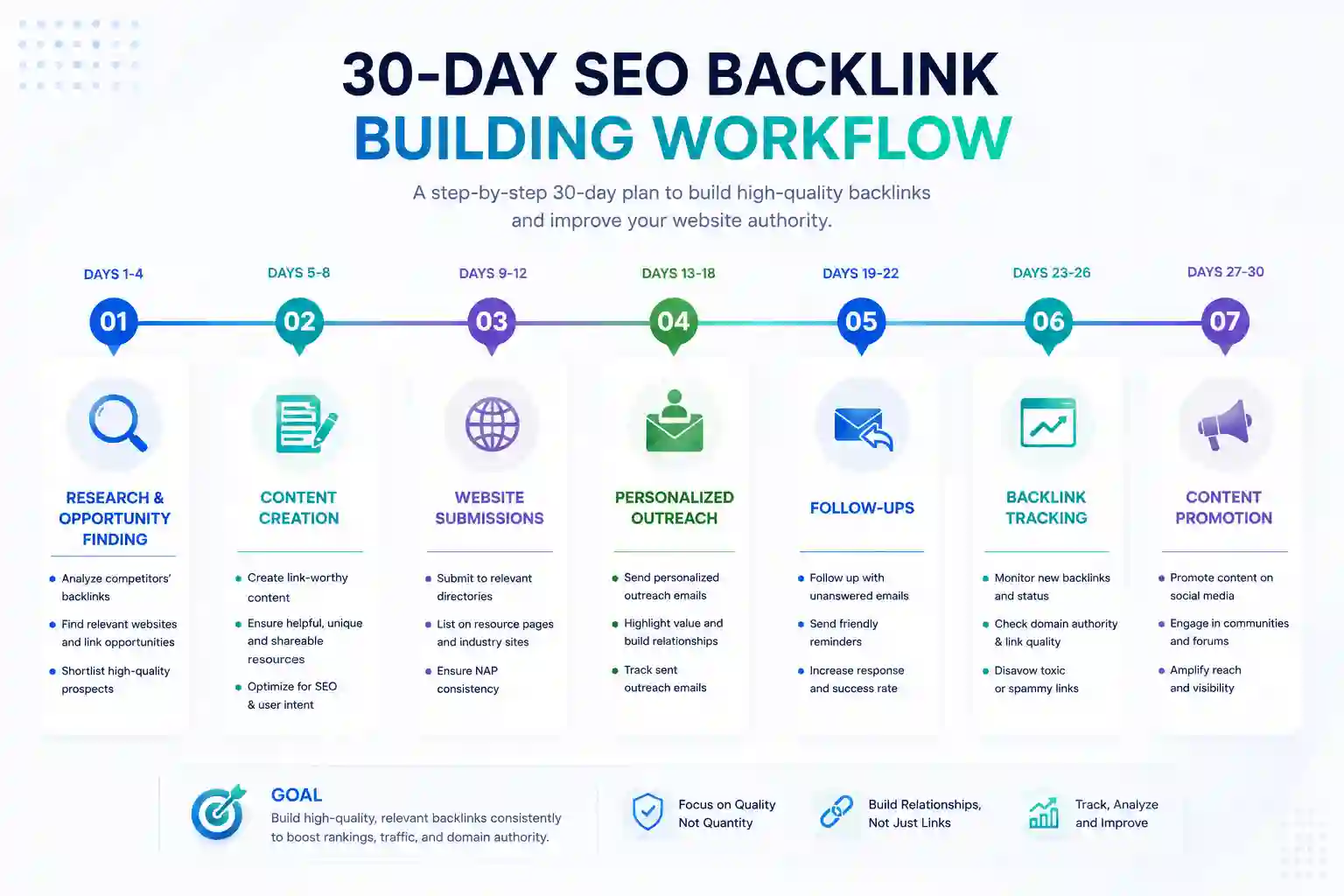
How to Build Backlinks for Free: A Step-by-Step Plan
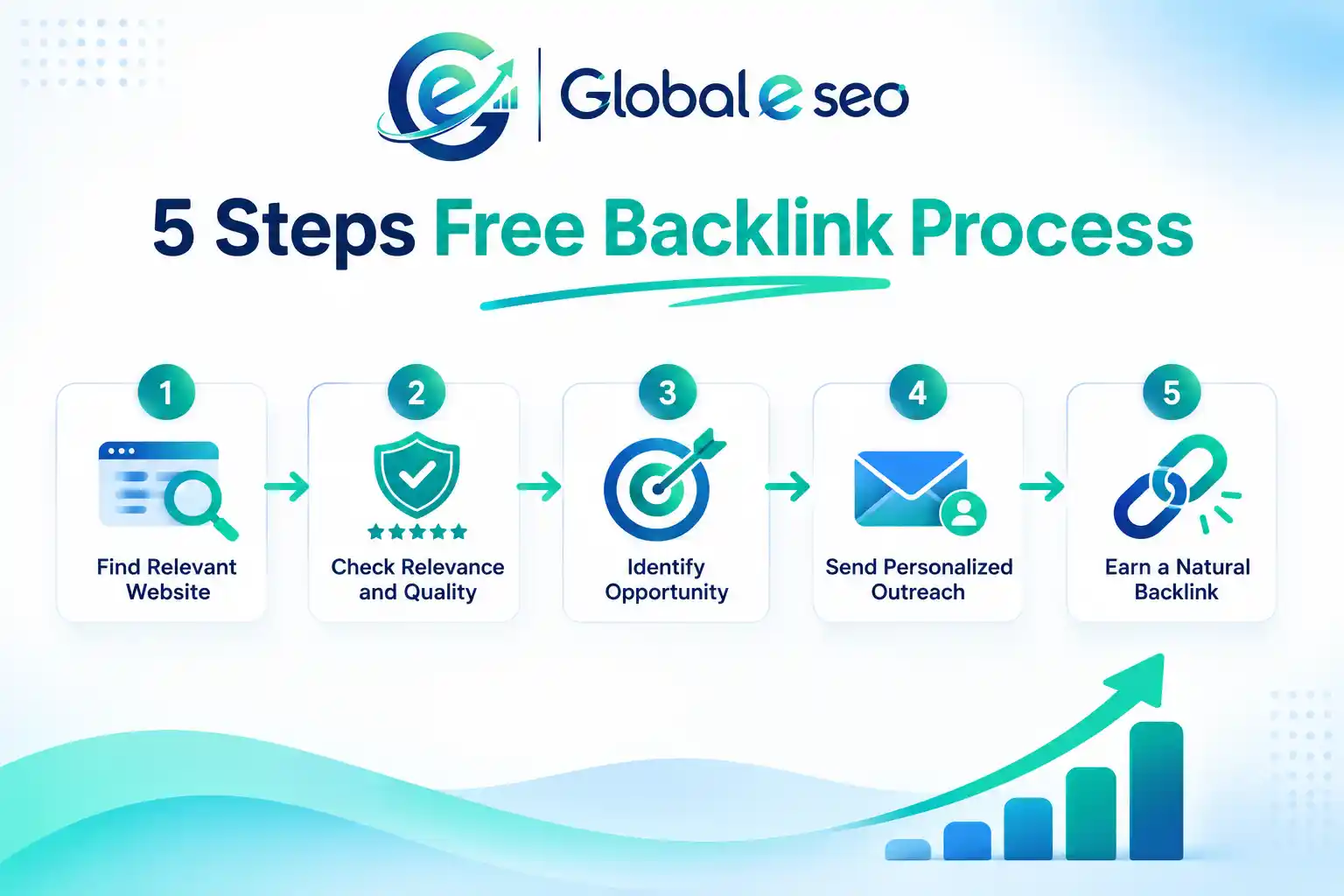
Here's a practical, no-cost framework for how to build backlinks for free, from start to finish.
Step 1: Choose an important page on your website Pick a page you genuinely want to rank — usually a cornerstone guide or service page.
Step 2: Improve the page before outreach Make sure the content is genuinely one of the best resources on the topic before asking anyone to link to it.
Step 3: Find relevant websites Use Google searches, competitor backlink data, and niche communities to build a list of potential link sources.
Step 4: Identify backlink opportunities Look for resource pages, broken links, guest post opportunities, and relevant site lists.
Step 5: Create useful supporting content If needed, create a specific asset (data, guide, or tool) that makes your outreach pitch stronger.
Step 6: Send personalized outreach Avoid generic templates. Mention something specific about their site and explain why your resource genuinely helps their readers.
Step 7: Submit to relevant free site lists and directories Add your website to legitimate, relevant listings — such as industry directories or curated site lists like GlobalESEO.com — following their submission guidelines carefully.
Step 8: Track acquired backlinks Use Google Search Console or a free tool tier to monitor new referring domains and confirm links are live.
Step 9: Continue creating link-worthy content Link building isn't a one-time task. Keep publishing valuable content so backlinks continue to accumulate over time.
How to Get Quality Backlinks for Free
Understanding how to get quality backlinks for free comes down to recognizing what actually makes a backlink valuable:
- Topical relevance — The linking site covers a related subject.
- Trustworthy website — The domain has a real reputation and history.
- Relevant page — The specific page linking to you fits the topic, not just the domain overall.
- Natural placement — The link fits contextually within the content.
- Useful surrounding content — The page itself is well-written and valuable to readers.
- Real audience — The site attracts genuine visitors and engagement.
- Editorial context — The link was added because it genuinely helps the reader, not because it was paid for or automated.
One relevant, editorially placed backlink from a trusted site in your niche is often more valuable than dozens of irrelevant or spammy links. Search engines evaluate context, not just link count, so prioritizing quality will serve your long-term SEO far better than chasing volume.
Free SEO Backlinks: Mistakes to Avoid
When pursuing free SEO backlinks, it's just as important to know what to avoid as what to do:
- Buying links solely to manipulate rankings — This violates search engine guidelines and carries real risk.
- Link farms — Networks of sites that exist only to exchange or sell links.
- Automated backlink software — Tools that mass-generate low-quality links with no editorial oversight.
- Mass directory submissions — Submitting to hundreds of directories regardless of relevance or quality.
- Irrelevant directories — Listings that have nothing to do with your niche.
- Spam comments — Dropping links in blog comment sections purely for SEO value.
- Excessive exact-match anchor text — Repeating the same keyword-rich anchor text unnaturally across many links.
- Mass automated outreach — Sending identical, unpersonalized pitches to hundreds of sites at once.
- Low-quality guest-post networks — Sites that exist solely to sell guest post placements with links.
- PBNs (Private Blog Networks) or other manipulative link schemes — Networks of sites built purely to pass link value artificially.
The core difference between legitimate promotion and manipulative link building is intent and value. Legitimate methods aim to genuinely help readers and earn links as a natural byproduct. Manipulative methods exist solely to trick search engines, and they carry real risk of penalties over time.
How Long Does It Take to Get Backlinks?
There's no fixed timeline. Getting backlinks can take anywhere from a few days to several weeks or months, depending on your strategy, your niche, the quality of your content, and how much outreach effort you put in.
Broken-link outreach or directory submissions might produce results within days. Earning links through original research or relationship-building often takes longer but tends to produce more durable, higher-quality results. It's important not to expect instant ranking improvements from a handful of backlinks — SEO is a long-term, cumulative process, and no single link or strategy can guarantee a specific outcome in search results.
How to Find Free Backlink Opportunities
Here are practical ways to consistently find new opportunities:
- Google searches — Use operators like
"add your site","resources", or"guest post"combined with your niche keywords. - Competitor backlink research — Use a free tool tier to see which sites link to competitors, then evaluate similar opportunities for yourself.
- Resource pages — Search for curated link pages relevant to your topic.
- Relevant directories — Look for niche or local directories rather than generic ones.
- Site lists — Submit to legitimate, relevant listings such as GlobalESEO.com's site list.
- Broken links — Scan popular pages in your niche for dead links you could replace.
- Industry websites — Identify blogs, news sites, and publications that regularly cover your topic.
- Communities — Participate genuinely in forums, Slack groups, and social communities in your niche.
- Original research — Publish data that other sites will want to cite.
- Useful tools — Use free SEO tools to track opportunities and monitor your growing backlink profile.
FAQ
1. How can I get free backlinks? Focus on creating genuinely useful content, submitting to relevant directories and site lists, doing broken-link outreach, and building real relationships with other website owners in your niche.
2. Are free backlinks good for SEO? Yes, as long as they're relevant and come from legitimate sources. A free backlink from a spammy or irrelevant site offers little to no SEO value and can occasionally do more harm than good.
3. What are the best free backlink sites? Look for relevant industry directories, curated site lists like GlobalESEO.com, and resource pages within your niche. Avoid generic, low-quality directories with no real editorial standards.
4. Can I build backlinks without money? Yes. Content creation, outreach, directory submissions, and relationship-building are all effective, completely free approaches to link building.
5. What are the best free link building tools? Google Search Console, Ahrefs Webmaster Tools, Moz Link Explorer's free tier, and browser extensions for broken-link checking are all useful starting points.
6. How do I get quality backlinks for free? Prioritize relevance, trustworthy websites, and natural, editorial placement over sheer link volume. One relevant backlink can outperform many low-quality ones.
7. Are comment backlinks useful? Generally, no. Most comment links are nofollow and offer little SEO value, and excessive comment linking can look spammy.
8. Should beginners buy backlinks? No. Buying links to manipulate rankings violates search engine guidelines and carries the risk of penalties.
9. How many backlinks should a new website build? There's no fixed number. Focus on consistently earning a handful of relevant, quality backlinks each month rather than chasing a specific total.
Conclusion
Learning how to get backlinks without spending money comes down to consistency, relevance, and genuine value. The most effective free methods include creating link-worthy content, submitting to relevant directories and site lists, using broken-link outreach, publishing original research, and building real relationships with people in your industry.
Throughout this process, remember that quality always outweighs quantity. A handful of relevant, naturally earned backlinks from trustworthy websites will do far more for your website authority and off-page SEO than a large volume of spammy, irrelevant links ever could. Avoid manipulative shortcuts, stay patient, and treat link building as an ongoing part of your overall SEO strategy rather than a one-time task.
With consistent effort, the free strategies covered in this guide can help you build a healthy, natural backlink profile — all without spending a single dollar. And when you're ready to scale beyond DIY tactics, our team at Global-E-SEO can help you build on that foundation.