
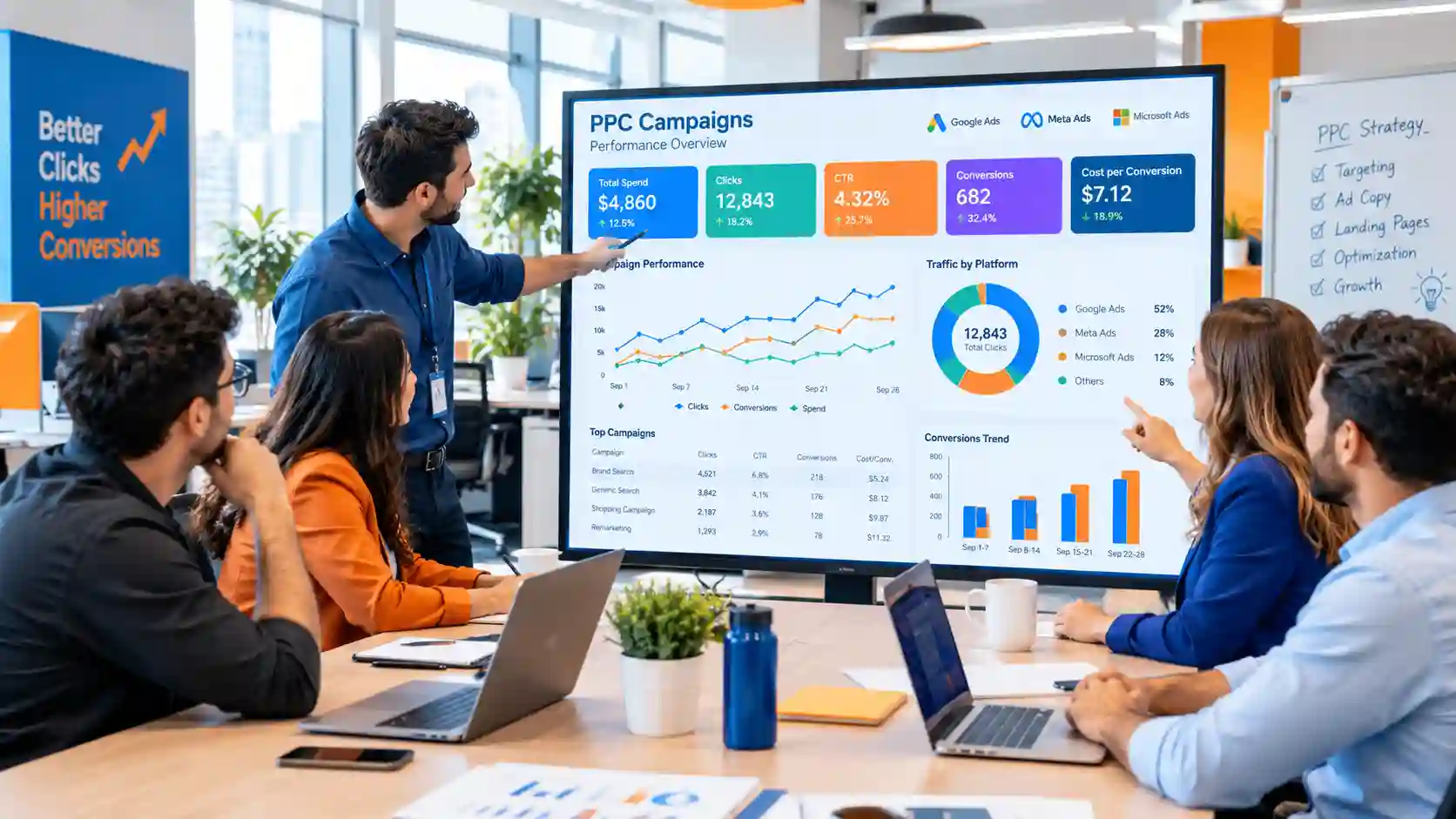
Every business wants to be found by people who are ready to buy. Organic rankings take months to build, and social posts disappear within hours. Pay-per-click (PPC) advertising offers a faster route: you bid for a spot in front of people already searching for what you sell, and you pay only when they click.
Table of Contents
The catch is that PPC is easy to start and hard to do well. Anyone can launch a campaign in an afternoon, and many businesses burn through budget just as quickly. A PPC advertising agency exists to close that gap, so every dollar you spend is tracked, tested, and tied to a business outcome.
This guide explains what an agency does, how it works day to day, and how to tell whether you’re getting your money’s worth.
What Exactly Does a PPC Advertising Agency Do?
Think of a PPC agency as an outsourced advertising department. Instead of hiring a strategist, a copywriter, a data analyst, and a platform specialist separately, you get all of those skills under one roof.
Agencies typically manage campaigns across:
- Google Ads, for search, display, shopping, and YouTube placements
- Microsoft Advertising, which reaches Bing and its partner network
- Meta Ads, covering Facebook and Instagram
- LinkedIn, TikTok, and Pinterest, depending on where your audience spends time
A typical team includes a campaign manager, a creative or copy specialist, and an analyst who watches the numbers. They share one goal: turning clicks into customers rather than just collecting traffic.
Step One: A Strategy Built Around Your Business
Good PPC starts long before an ad goes live. A skilled agency begins by learning how your business actually makes money. That means asking questions like:
- What is a new customer worth to you over time?
- Which products or services carry the best margins?
- Who is your ideal buyer, and where are they located?
- What do your competitors bid on, and where are they weak?
The answers shape everything that follows: the budget split, the platforms chosen, and the targets the campaigns must hit. An agency that skips this step and jumps straight into building ads is guessing with your money.
Competitor research matters here too. By studying rival ads, landing pages, and keyword choices, an agency finds gaps you can exploit, such as a niche search phrase no one is bidding on or a customer pain point nobody addresses.
Keywords: The Foundation of Search Advertising
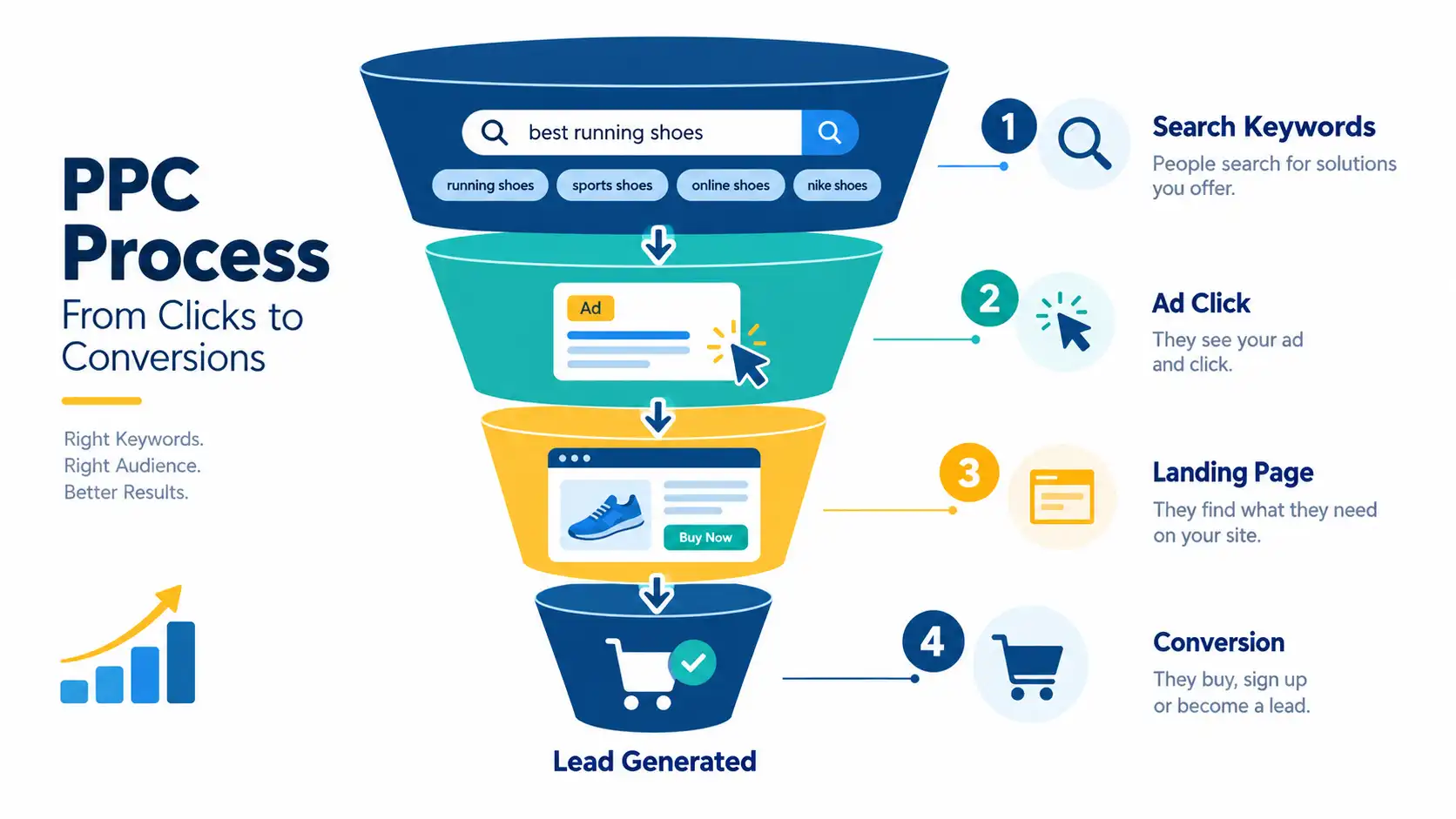
In search campaigns, keywords decide who sees your ad. Pick the wrong ones and you attract browsers who never buy. Pick the right ones and you meet buyers at the exact moment they’re ready to act.
Professional keyword work goes beyond picking popular terms. Agencies look at:
- Search intent. Someone searching “what is a CRM” is learning. Someone searching “best CRM for small law firms pricing” is shopping.
- Match types. Broad, phrase, and exact match give different levels of control over who triggers your ads.
- Negative keywords. Blocking irrelevant searches (like “free” or “jobs”) stops wasted clicks before they cost you.
- Cost versus value. A keyword that costs more per click can still be the better investment if it converts well.
Negative keywords alone often save businesses a surprising share of their budget, and it’s one of the first things an experienced manager checks.
Writing Ads That Earn the Click
Ranking high means little if nobody clicks. Ad copy is where psychology meets space limits: you have a handful of characters to stand out among competing offers.
Strong PPC copywriting usually does four things:
- Mirrors the search. When your headline echoes the words someone just typed, it feels relevant instantly.
- Leads with a benefit. “Cut your energy bill by 30%” outperforms “Premium solar installation services.”
- Builds trust. Reviews, years in business, guarantees, and certifications ease the hesitation.
- Ends with a clear next step. “Get a free quote today” tells people exactly what happens after the click.
Agencies rarely settle on one version. They run A/B tests, comparing headlines, descriptions, and calls to action, then keep the winners and retire the losers. Over months, small improvements in click-through rate compound into noticeably lower costs.
The Landing Page: Where Clicks Become Customers
Many businesses blame their ads when the real problem sits one click later. If your ad promises a discount and the landing page buries it under a generic homepage, visitors leave, and you’ve paid for nothing.
A thorough agency reviews the full journey. They look at page speed, mobile layout, headline match, form length, and trust signals. Sometimes they recommend building dedicated landing pages for each campaign so that the message stays consistent from ad to action. Even modest gains in conversion rate can transform profitability, because the same ad spend now produces more customers.
Ongoing Optimization: Where the Real Value Lives
Launching a campaign is the beginning. The weeks and months afterward are where agencies earn their fee.
Your manager will watch core numbers such as:
- Click-through rate (CTR), which shows how appealing your ads are
- Cost per click (CPC), which reveals how competitive your market is
- Conversion rate, which measures how well traffic turns into leads or sales
- Cost per acquisition (CPA), which tells you what a customer actually costs
- Return on ad spend (ROAS), which compares revenue to what you spent
Using this data, they adjust bids, shift budget toward winning campaigns, pause underperformers, refine audiences, and refresh tired creative. Modern platforms add automated bidding powered by machine learning, but automation works best when guided by a human who feeds it clean conversion data and sensible goals.
Staying Ahead of a Moving Target
Advertising platforms change constantly. Google updates its match-type behavior, privacy rules reshape tracking, and new formats such as AI-assisted campaigns and video placements keep appearing. Audiences shift too, with more searches happening on phones, by voice, and inside apps.
A good agency treats this as part of the job. It tests new features cautiously, keeps your tracking compliant with privacy rules, and adjusts strategy when the rules shift, so your campaigns don’t quietly decay while you focus on running your business.
Reporting You Can Actually Understand
Results you can’t see are results you can’t trust. The best agencies share clear, regular reports that connect numbers to outcomes: how many leads came in, what they cost, and what revenue followed.
Look for reports that include:
- Plain-language summaries rather than walls of metrics
- Month-over-month comparisons
- Notes on what was tested and what was learned
- Specific next steps and recommendations
You should also have access to your own ad accounts. A trustworthy agency never holds your data hostage.

How to Choose the Right PPC Agency
Not all agencies are equal, so ask these questions before signing:
- Can you show results in my industry? Case studies with real numbers beat vague promises.
- Who will manage my account? Find out whether you’ll work with an experienced specialist or a rotating junior team.
- How do you charge? Common models include a flat monthly fee, a percentage of ad spend, or a hybrid. Make sure incentives line up with your goals.
- What does reporting look like? Ask to see a sample.
- Will I own my accounts and data? The answer should always be yes.
- Are there long contracts? Confident agencies don’t need to lock you in.
Be wary of anyone guaranteeing first-page results overnight or specific sales numbers. PPC performance depends on competition, offer, and market conditions, and honest agencies talk in ranges and tests, not certainties.
Is a PPC Agency Worth It?
If you have a small, simple campaign and time to learn the platforms, managing it yourself can work. But as budgets grow, so does the cost of mistakes. A few poorly chosen keywords or an untested landing page can waste more than the agency’s fee. For most growing businesses, expert management pays for itself through lower acquisition costs, faster learning, and hours saved.
Final Thoughts
PPC advertising rewards precision. The businesses that win aren’t necessarily those spending the most. They’re the ones that understand their customers, test relentlessly, and let data guide every decision. A capable PPC advertising agency brings that discipline, along with the tools and experience to apply it.
If you’re ready to stop guessing and start growing, choose a partner who is transparent, results-focused, and invested in your success. Your ad budget will go much further when someone is watching every click.